
What autonomous robots can and cannot do in business? Myths, reality and practical examples
In recent years, autonomous robots have rapidly moved from futuristic technologies into everyday business reality. Today we find them in hotels, restaurants, hospitals, shopping centers, factories, logistics warehouses and office buildings, where they contribute to operational efficiency and improving customer experience.
As interest in automation grows, a natural question arises:
What can autonomous robots really do and where are their limitations?
There is still a perception that a robot can fully replace an employee or operate without any human intervention. However, the reality is more nuanced.
At Torecofollowing the implementation of PUDU Robotics robots in various types of businesses, we have observed that the best results appear when technology and people work together a collaborative model “COBOTIC”, in which humans and robots work together.
Robots take over repetitive, time-consuming and resource-intensive tasks, while staff can focus on tasks that require attention, creativity and human interaction.
This is why autonomous robots should not be seen as human replacements, but as tools that help companies operate more efficiently.
Why are more and more companies investing in autonomous robots?
In almost all industries there are three common challenges:
Managers must do more with the same or even fewer resources.
In this context, autonomous robots offer advantages that are hard to ignore:
Unlike employees, robots do not get tired, do not forget process steps and do not lose focus after hours of work.
However, this does not mean they can do everything.
Myth No. 1: “The robot will completely replace staff”
This is probably the most widespread myth.
In practice, companies that achieve the best results do not reduce the role of people, but transform it.
Let’s take the example of a hotel.
Instead of staff spending hours transporting linens, consumables or other materials, a robot can take over these repetitive movements. Thus, employees can dedicate more time to guests and activities that bring real value to the customer experience.
The same principle applies in restaurants, hospitals or shopping centers.
The robot performs repetitive and predictable tasks.
The human handles complex and unexpected situations.
This combination produces the best results.
Myth No. 2: “The robot can do anything”
Current technology is impressive, but it is not magic.
Even the most advanced autonomous robots have certain limitations.
For example:
In cleaning operations, extremely difficult stains or unusual situations may require human inspection and intervention.
In autonomous delivery, the robot can transport goods, but customer interaction remains the responsibility of staff.
In other words, the robot is excellent for repetitive and standardized processes, but it does not replace human judgment.
What makes robots so intelligent?
The difference between today’s robots and those from a few years ago is enormous.
Current models simultaneously use:
These systems allow the robot to:
If a corridor is temporarily blocked, the robot can recalculate its route and continue working without human intervention.
This capability transforms autonomous robots from simple machines into true operational assistants.
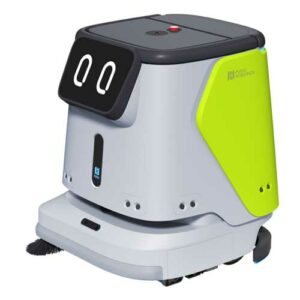
CC1 - The robot changing the way we see professional cleaning
In autonomous cleaning, one of the most advanced models in the Toreco portfolio is CC1.
CC1 is not just a floor scrubbing robot.
It is an autonomous cleaning platform capable of performing multiple operations in a single working cycle:
The robot can work autonomously in:
After completing its task, it can return independently to its station for charging and preparation of the next schedule.
The result is consistent and predictable cleaning, regardless of time of day.
MT1 – Autonomous cleaning for large surfaces
In industrial halls and logistics warehouses, the challenges are different.
Surfaces are very large, and accumulation of dust and debris can affect both safety and operational efficiency.
For these situations MT1 was developed.
The robot is designed for:
MT1 can cover large surfaces in a consistent and efficient way, reducing time and effort required for daily maintenance.
Instead of staff spending hours performing the same routes, the robot executes this activity autonomously and repeatedly.
SH1 – Intelligent assistant for professional cleaning
Not all spaces allow the use of large equipment.
There are areas that require flexibility and high maneuverability.
SH1 was developed to meet exactly this need.
It provides the advantages of automation in a format adapted to spaces requiring fast and efficient interventions.
In combination with large autonomous robots, SH1 contributes to a complete professional cleaning ecosystem.
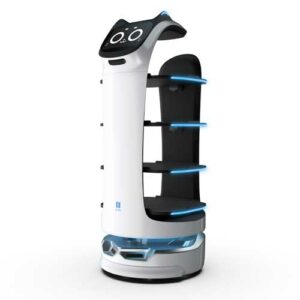
BellaBot – The robot transforming customer experience
If in cleaning the focus is efficiency, in hospitality the focus shifts to experience.
BellaBot is probably one of the most well-known service robots in the world.
Its friendly design and interaction capabilities make it an instant attraction for customers.
BellaBot can transport:
In restaurants, hotels and cafes, it reduces repetitive movements of staff and contributes to creating a memorable customer experience.
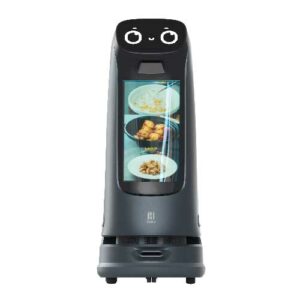
KettyBot – Advertising and delivery in one robot
In many businesses, every square meter must generate value.
KettyBot combines two important functions: autonomous delivery; digital promotion.
Its large screen allows displaying:
At the same time, the robot can transport products and guide visitors through the space.
This makes it suitable for:restaurants; showrooms; shopping centers; hotels; events.
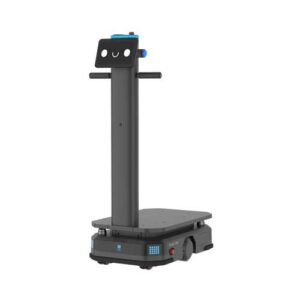
Pudu T300 – autonomous transport for internal logistics at an industrial level
In many companies, one of the most time-consuming activities is not cleaning or customer interaction, but constant internal transport:moving boxes and containers; delivering materials between workstations; supplying production lines; moving consumables and equipment; optimizing internal logistics flows repeatedly transported between fixed points.
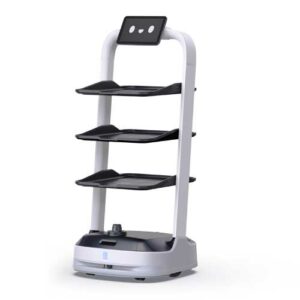
In this context, Pudu T300 is designed as an autonomous transport robot for heavy-duty tasks (up to 300 kg) and continuous logistics flows in complex environments.
The robot follows defined or dynamic routes adapted to the working environment and can operate alongside human staff in active spaces.
Pudu T300 - это автономный промышленный транспортный робот, предназначенный для автоматизации внутреннего перемещения товаров в: factories; logistics centers; hospitals; large hotels; shopping centers; industrial and production environments.
Unlike classic delivery robots, T300 is focused on volume, weight, and operational efficiency in repetitive workflows..
PuduBot2 – Reinvented internal logistics
Internal transport is one of the most time-consuming activities in many organizations.
In hospitals, hotels, factories or warehouses, employees often spend hours moving materials from one area to another.
PuduBot2 was created to automate exactly these processes.
The robot can transport: consumables; documents; equipment; products; logistics materials.
Thanks to autonomous navigation and obstacle avoidance, it can operate safely even in crowded environments.
The result is simple:more time for productive activities.
Where do autonomous robots excel?
Experience from implementations across industries shows that robots deliver the best results when:
In these conditions, return on investment can be achieved much faster than initially estimated.
Where are humans needed?
Despite technological progress, there are activities where human factor remains essential:
That is why -the most successful organizations do not choose between humans and robots. They use both intelligently.
The future belongs to collaboration between humans and robots
In the coming years, autonomous robots will become even smarter, more connected and more integrated into business processes.
They will generate more data, make faster decisions and communicate more effectively with building infrastructure and digital systems.
However, one thing is unlikely to change: Success will not come from replacing people. Success will come from collaboration between humans and technology.
Autonomous robots such as CC1, MT1, SH1, BellaBot, KettyBot and PuduBot2 already demonstrate that the future does not mean fewer employees, but people using their time more efficiently and focusing on what truly matters.
Robots handle large surfaces and repetitive tasks, while staff handle operations requiring attention, flexibility and decision-making.
This hybrid “COBOTIC”approach, where humans and robots work together, allows achieving the best balance between productivity, operational efficiency and quality.
The most efficient solution is collaboration between humans and robots.
They represent the present.
We use various cookies on our website to provide you with the best browsing experience. These technologies may collect data such as your IP address, site usage information and approximate location. You can accept all optional cookies, reject them, or customise your preferences.
Politica de cookies